Federal Judge Strikes Down Trump’s Visa Ban Covering Nigeria and 74 Other Countries

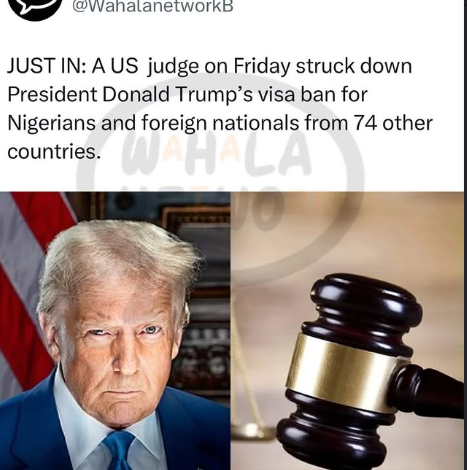
Big news for millions of hopeful immigrants worldwide, including a huge number of Nigerians. The Trump administration’s ban on immigrant visas for nationals of 75 countries was struck down by a federal judge on Friday, who ruled it was “contrary to law” and outside the statutory authority of Secretary of State Marco Rubio.
The Ruling, In Detail
U.S. District Judge Jeannette Vargas, sitting in Manhattan, described the January directive from the State Department as “patently unlawful.” In her ruling, she found the policy conflicted with the structure of federal immigration law, rejecting the administration’s attempt to use an applicant’s nationality as the basis for a blanket suspension of immigrant visa issuance. Her written judgment put it bluntly: “The Policy, which categorically prohibits the issuance of immigrant visas based upon the nationality of the applicant, represents a direct abrogation of this statutory scheme.”
Vargas found that, in practice, US officers were ordered to reject visas for applicants even those who could clearly support themselves solely based on the country they came from. Under existing law, an immigrant can only be turned away as a likely “public charge” after a consular officer actually weighs that individual’s own finances, age, health, skills and family situation, not their nationality alone.
What the Ban Actually Covered
The US Department of State introduced the suspension effective January 21, 2026, citing concerns that nationals from the affected countries were at high risk of relying on public benefits in the United States. The visa ban specifically halted permanent-residence visas for people joining family members or taking jobs in the US it did not apply to nonimmigrant visas such as tourist or student visas. Under the policy, affected nationals could still submit applications and attend interviews, but actual visa issuance was paused.
The full list of 75 affected countries spanned Africa, Asia, the Middle East, Europe, the Caribbean, and Latin America including, alongside Nigeria, African nations like Algeria, Cameroon, Cape Verde, DR Congo, Egypt, Eritrea, Ethiopia, and The Gambia, plus countries such as Afghanistan, Bangladesh, Brazil, Colombia, Cuba, Haiti, India, Iran, Iraq, Pakistan, Russia, Ukraine, and Yemen, among many others.
How the Administration Defended It — And Why the Judge Disagreed
State Department spokesperson Tommy Pigott had defended the move at the time, saying: “The State Department will use its long-standing authority to deem ineligible potential immigrants who would become a public charge on the United States and exploit the generosity of the American people.” In court, the administration’s legal team leaned on a 2018 Supreme Court decision that upheld the third version of Trump’s first-term travel ban. Vargas rejected that comparison, noting that the earlier case turned on the president’s power to decide who may enter the country, whereas this case rested on a fundamentally different question whether a visa may be issued at all.
Who Brought the Case
The lawsuit was filed by immigrant rights organisations Catholic Legal Immigration Network and African Communities Together, alongside individual applicants for immigrant visas and US citizens who were in the process of sponsoring family members. Their argument centered on a straightforward point: the federal government cannot simply suspend immigrant visa issuance for people from selected countries without following the legal framework Congress actually established and Judge Vargas agreed.
What Happens Next
Vargas has given both sides until September 11 to propose how to resolve what remains of the case, and the administration retains the option to appeal the ruling. The State Department did not immediately respond to requests for comment on the ruling. Legal observers have also noted that this visa suspension was part of a broader wave of immigration restrictions introduced by the administration in quick succession, including a separate travel ban covering 39 countries that took effect January 1, and a pause on diversity visa issuance introduced in late December.
Wahala Network Take
For countless Nigerian families with pending visa applications, sponsors, and loved ones caught in limbo since January, this ruling is genuinely significant though it’s worth remembering an appeal is still possible, and the case isn’t fully closed until the September 11 deadline plays out. Real people’s immigration futures are riding on how this continues to unfold.
We’ll keep following this story closely.