FIFA Drops the Hammer: 17 Combined Games Banned After Argentina-Spain World Cup Final Turned Into a Brawl

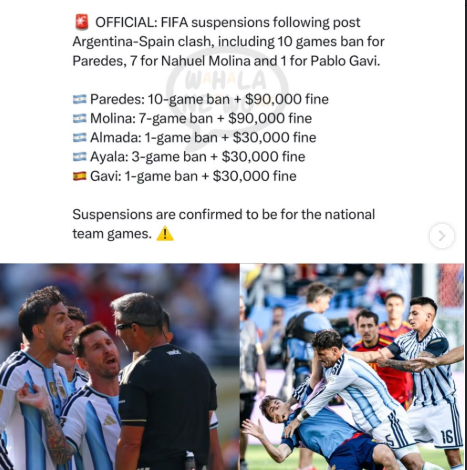
The World Cup final between Argentina and Spain ended over a month ago, but the fallout is only just landing and it’s severe. FIFA has officially suspended four Argentine players and one team official, alongside Spain’s Gavi, following the ugly scenes that broke out immediately after the final whistle in New Jersey.
What Actually Happened On The Pitch
Spain won the final 1-0 courtesy of a Ferran Torres goal in extra time</cite>, but the real chaos came after the whistle blew. As Spain celebrated their second star, Leandro Paredes pushed and then grabbed Eric García by the neck. Gavi intervened, was held by Thiago Almada, and was then struck by Paredes. Others joined the melee, including Nahuel Molina, while Argentina assistant coach Roberto Ayala punched Dani Olmo on the chin. The scuffle came after a tense final in which Argentina midfielder Enzo Fernández had already been sent off, and Argentina coach Lionel Scaloni ultimately had to intervene personally to calm things down.
The Punishments, Broken Down
Leandro Paredes received a 10-game suspension and a $90,000 fine for grabbing Eric García by the throat and later throwing Gavi to the ground. Nahuel Molina was handed a seven-game suspension and the same $90,000 fine for apparently striking Rodri in the stomach. Thiago Almada received a one-game ban and a $30,000 fine for unsporting behavior, while team official Roberto Ayala was suspended for three matches and fined $30,000 for assault. On the Spanish side, Gavi received a one-game suspension and a $30,000 fine, also for unsporting behavior.
Why Paredes’ Ban Is Genuinely Historic
The ban handed to Paredes ranks alongside FIFA’s sanction of Luis Suárez in 2014 as among the most severe in World Cup history. Because the suspension applies to national team fixtures and the FIFA calendar runs through 10 games until June 2027, the ban effectively amounts to a full year’s expulsion from the Argentina squad and all of those games could be friendlies, since no competitive fixtures are currently scheduled in that window.
There is an important silver lining for the players, though: the suspensions apply strictly to international matches, meaning none of the sanctioned players are barred from representing their clubs. They’ll serve their bans exclusively during future Argentina and Spain fixtures. Interestingly, Gavi had publicly stated before FIFA’s decision that he did not want Paredes to be suspended over the incident a detail that adds a strange note of sportsmanship to an otherwise ugly story.
It’s Not Just the Players — Argentina’s Federation Got Hit Too
FIFA separately fined the Argentine Football Association $310,000 over the conduct of its fans, citing “using a sports event for demonstrations of a non-sporting nature,” discrimination and racist abuse, and issues with order and security at matches. Part of that fine relates to Argentina supporters displaying a banner reading “Las Malvinas son argentinas” (“The Falklands are Argentina”) following their semi-final win over England a politically charged message that FIFA explicitly flagged as a breach. As a result, the AFA now faces a combined $321,000 in fines and will be forced to play their next two matches at 50 percent stadium capacity.
The Bigger Picture
FIFA’s Disciplinary Committee formally opened proceedings against all five sanctioned individuals back on July 29, following official reports from the final. For a tournament that already ended with heavy hearts in Argentina Messi’s final World Cup run concluding without another title at age 39, closing out six tournaments, over 200 caps, and 125 international goals this disciplinary fallout adds a bitter postscript to what should have been a celebratory send-off narrative regardless of the result.
Wahala Network Take
Losing a World Cup final is painful enough without your two most important midfielders getting banned for a combined 17 international matches on the way out. Argentina now has to rebuild its squad depth for over a year of fixtures without Paredes and Molina proof that sometimes the real cost of a bad night isn’t the scoreline, it’s what happens after the final whistle.