“Impossible to Be a Billionaire Without Being Corrupt” — Comedian David Feldman’s Blunt Take Goes Viral

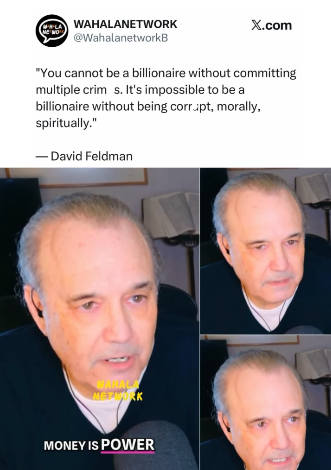
It’s not a new argument, but the way it was said this time has people talking. Political commentator and comedian David Feldman just delivered one of the bluntest takedowns of extreme wealth making the rounds online right now and it’s landing hard.
The Quote
In a clip circulating widely on social media, David Feldman didn’t mince words: “You cannot be a billionaire without committing multiple crimes. It’s impossible to be a billionaire without being corrupt, morally, spiritually.” He went further, tying the point directly to power dynamics, arguing that money equals power and that billionaires simply have too much of it.
It’s a short, punchy soundbite, but it’s built on an argument Feldman has made across his broader body of work for years.
Who’s Actually Saying This
For anyone unfamiliar with the name, David Feldman is an American stand-up comedian, comedy writer, and political podcaster, best known as host of the long-running David Feldman Show a politically opinionated news commentary podcast blending sharp political analysis with comedic delivery. He’s also a longtime co-host of the Ralph Nader Radio Hour alongside consumer advocate Ralph Nader, and has contributed commentary to outlets like Salon. His podcast has built a reputation for aggressive, left-leaning takedowns of political and corporate power, frequently targeting billionaires, government officials, and corporate wrongdoing with a mix of hard-hitting commentary and satire.
In other words, this isn’t a random hot take from an anonymous account it’s consistent with years of Feldman’s on-air commentary style, just condensed into a viral, shareable clip.
Is There Anything to the Argument?
Feldman’s claim is deliberately provocative, but it’s not coming out of nowhere it echoes a real, ongoing debate among economists, journalists, and policy commentators about how extreme wealth actually gets accumulated at the very top.
Investigative reporting in recent years most notably ProPublica’s landmark 2021 exposé based on leaked IRS data revealed just how aggressively many of America’s wealthiest individuals minimize their tax bills, often paying a smaller effective tax rate than average workers, through strategies that are technically legal but widely viewed as ethically dubious. Commentators have pointed to a string of high-profile cases over the past decade highlighting outright criminal conduct among the ultra-wealthy too, from tax evasion settlements to securities fraud prosecutions, arguing that white-collar crime among billionaires is far more common than the “clean and legal” image usually presented in the media.
That said, Feldman’s framing that it’s flatly “impossible” to become a billionaire without committing crimes is an absolute claim, and absolute claims are, by nature, harder to defend than more measured critiques of wealth concentration. Plenty of economists and commentators draw a sharper distinction between legal-but-ethically-questionable tax strategies (which are common) and outright criminal conduct (which, while not rare among billionaires, isn’t universal either). The “moral and spiritual corruption” part of Feldman’s argument is much less a factual claim than a value judgment one plenty of people share, and plenty of others reject outright.
Why This Debate Keeps Resurfacing
Billionaire wealth has become one of the most reliably polarizing topics in political discourse, and for good reason the gap between how the ultra-wealthy are perceived by critics and how they’re often portrayed in mainstream coverage has widened noticeably in recent years. Progressive commentators and politicians have increasingly argued that concentrated wealth is inherently corrosive to democracy, pointing to billionaires’ outsized influence in politics through campaign donations, lobbying, and now, increasingly, direct ownership of media and tech platforms that shape public discourse itself.
On the other side, defenders of extreme wealth argue that not all billionaires are created equal pointing to entrepreneurs who built genuinely valuable companies through innovation rather than exploitation, and cautioning against painting an entire, enormously varied group of people with one broad brush.
Feldman’s clip captures that first camp’s argument about as bluntly as it’s possible to state it which is exactly why it’s spreading. Statements framed as absolute, unqualified truths tend to travel further online than nuanced ones, for better or worse.
The Bottom Line
Whether or not you buy the “impossible” framing, Feldman’s underlying point that extreme wealth accumulation and moral compromise tend to travel together far more often than polite society likes to admit is one that’s been gaining traction in public discourse for years, particularly as tax-avoidance revelations and corporate scandals involving the ultra-rich keep piling up.
Agree with him or not, it’s clear this particular clip tapped into something a lot of people are already thinking even if they wouldn’t phrase it quite as bluntly as Feldman just did.