US to Pull 200 Troops Out of Nigeria — Here’s What Actually Happened, and Why It’s Not the Full Story

Breaking news headlines rarely tell you the whole journey. This one has a backstory that runs from a “guns-a-blazing” threat on Truth Social to a Grammy of a raid in the Lake Chad swamps and now, a quiet drawdown that the Pentagon is calling a success.
Here’s the full picture of what’s happening between Washington and Abuja, and what it actually means for Nigeria’s security situation going forward.
The Headline
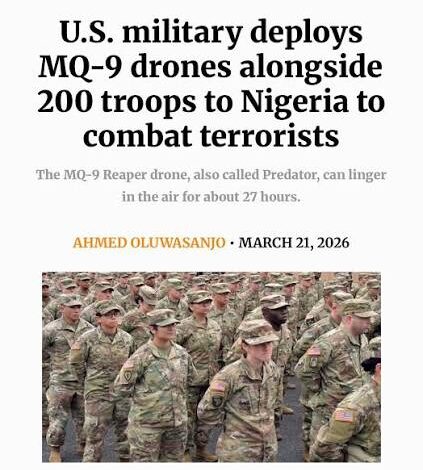
The United States is preparing to pull around 200 troops out of Nigeria, with the bulk of personnel expected to leave by late September. According to reporting from The New York Times, cited by multiple outlets, American and Nigerian officials say the deployment though small delivered real results in the fight against Islamist militants, particularly through intelligence-sharing and targeted counterterrorism operations.
Crucially, this isn’t a total pullout. Small teams of American trainers and intelligence analysts are expected to stay behind, keeping the security partnership between the two countries alive even as the larger contingent heads home.
How We Got Here: From Threats to Troops
To understand why 200 American service members were on Nigerian soil in the first place, you have to rewind to late 2025.
President Donald Trump spent weeks last November accusing the Nigerian government of failing to stop what he called a “genocide” of Christians, redesignating Nigeria as a “Country of Particular Concern” a formal US State Department classification for nations accused of severe religious freedom violations, a list that also includes North Korea, Russia, and Iran. Trump didn’t stop at labels. He threatened to cut off all US aid and warned the country could face a military response that would be “fast, vicious, and sweet,” instructing the Pentagon (rebranded under his administration as the Department of War) to “prepare for possible action.”
Nigeria pushed back hard. Officials in Abuja, including a spokesperson for the Ministry of Foreign Affairs, publicly denied that Christians were being singled out for persecution, while insisting any unilateral military intervention would violate the country’s sovereignty. Presidential spokesman Daniel Bwala told reporters Trump’s comments were built on “misleading reports.”
Then, on Christmas Day, the US backed up the rhetoric with action firing missiles into militant camps in the Bauni Forest in Sokoto State, in Nigeria’s northwest.
The Deployment and the Raid That Changed Things
By February 2026, the confrontation had shifted into cooperation. The US sent roughly 200 service members into Nigeria, officially described as a training and advisory mission rather than a combat deployment, focused on intelligence, surveillance, and counterterrorism support in the Lake Chad Basin the swampy, cross-border region where Nigeria, Niger, Chad, and Cameroon meet, and where ISIS-West Africa Province and Boko Haram remnants have operated for years.
The mission escalated that spring. Nigeria’s defense minister confirmed additional combat forces, including special operations personnel, were deployed for a specific operation in the Lake Chad region. Between May 15 and 18, US and Nigerian forces carried out a string of airstrikes and raids. The centerpiece was a joint operation targeting Abu-Bilal al-Minuki, described by American officials as the global second-in-command of ISIS.
Reporting citing multiple US officials described roughly two dozen commandos, including members of the elite SEAL Team 6, moving to capture al-Minuki. After a nearly three-hour firefight, the team called in an airstrike that killed him. Follow-up strikes in the days after reportedly left approximately 200 ISIS fighters dead in total.
“Mission Accomplished” — With Caveats
By July, Gen. Dagvin Anderson, head of US Africa Command, confirmed at the 2026 African Chiefs of Defense Conference that Washington had already withdrawn “much of our forces that were just there for that operation.” He credited the Lake Chad campaign with significantly disrupting ISIS’s leadership structure, both in Nigeria and globally, while noting Nigerian forces had stayed “very active” in following up on the gains.
Now, that drawdown is being finalized with the remaining roughly 200 troops expected to leave by late September, according to the New York Times report picked up widely across Nigerian and international media this week.
What’s notable is how US officials are framing it. Rather than describing it as a retreat, American officials reportedly see the Nigeria deployment as a template proof that a relatively small US military footprint, paired with strong intelligence cooperation and support for local forces, can produce major results without a large, sustained occupation. That’s the model Washington is said to be eyeing for future counterterrorism missions elsewhere in Africa.
The Part That Doesn’t Make the Victory Lap
Here’s the reality check: despite the high-profile win against ISIS’s leadership, insecurity in Nigeria hasn’t gone away. Militant attacks have reportedly continued in recent weeks, and security analysts caution that armed groups remain a serious threat, particularly across northern and central Nigeria a region also grappling with banditry, kidnapping-for-ransom, and separate insurgent factions that operate independently of the ISIS network the US-Nigeria operation targeted.
The withdrawal also comes against the backdrop of the still-unresolved diplomatic tension over Trump’s “Christian genocide” claims. Nigeria and the US have since held a second round of talks in Washington under a joint working group specifically set up to address the protection of Christian communities in Nigeria’s Middle Belt a sign that, even as combat troops head home, the political conversation triggered by Trump’s threats last year is far from over.
What Happens Next
For now, the practical takeaway is this: the large US troop presence built up earlier this year for a specific mission is winding down, but the intelligence-sharing relationship between Washington and Abuja isn’t. Small teams of trainers and analysts will remain on the ground, and both governments appear intent on keeping security cooperation alive even as the bigger, more visible military footprint packs up.
Whether that’s enough to keep pressure on the militant groups still active across Nigeria’s north remains the open question nobody in Washington or Abuja is fully answering yet.