
BREAKING: EFCC Drops Cybercrime Charges Against BUK Student and Co-Defendant After Backlash and a Father’s Plea

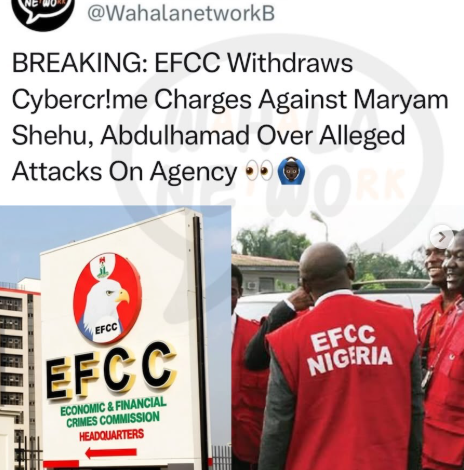
Barely 24 hours after two young Nigerians were remanded in correctional custody, the Economic and Financial Crimes Commission has done a dramatic U-turn. EFCC Executive Chairman Ola Olukoyede has ordered the withdrawal of charges against Maryam Isah Shehu and Abubakar Shuraim Abdulhamad, following a wave of public backlash and a personal appeal from one of their families.
How This Started
Shehu and Abdulhamad were arraigned on Thursday, August 20, 2026, before Justice Joyce Abdulmalik of the Federal High Court, Abuja, over allegations tied to social media posts about the commission. The charge against Shehu accused her of intentionally publishing a message via her Instagram account claiming EFCC officials assaulted a man named Ahmed Uthman on the instruction of a zonal director who allegedly collected ₦20 million from another individual an act the EFCC said amounted to willful character assassination of the Commission. Abdulhamad, meanwhile, was accused of using his X account to publish an image resembling an official EFCC arrest placard, allegedly portraying one Sadeeq Kabeer as a suspect with the caption: “His only crime was selling laptops at an affordable price to students.”
Both charges were brought under Section 24(2)(c) of the Cybercrimes (Prohibition, Prevention, Etc.) Act, 2015, as amended in 2024. Following their arraignment, Justice Abdulmalik ordered that Shehu be remanded at the Suleja Correctional Centre and Abdulhamad at Kuje Correctional Centre, with the matter adjourned to August 31 for bail hearings and the start of trial. Shehu was identified as a final-year student at Bayero University Kano (BUK).
The Backlash That Followed
The remand of two young Nigerians into prison custody over social media posts drew swift criticism from lawyers and members of the public, with the case sparking wider conversations about how far cybercrime laws should stretch when it comes to public criticism of government agencies. The National Association of Nigerian Students (NANS) confirmed it had directly engaged EFCC leadership, stating its intervention was aimed at “securing a resolution that would enable Shehu to continue her studies without disruption,” and describing its approach as one of “dialogue and constructive engagement” to protect students’ academic interests.
The Reversal
In a statement, EFCC’s Head of Media and Publicity, Dele Oyewale, confirmed that Olukoyede had directed the withdrawal of the charges “after considering the passionate pleas and apologies offered by Shehu’s father, as well as appeals from well-meaning Nigerians.” The Commission maintained that the original arraignment was properly grounded in law, but chose leniency regardless. Olukoyede did add a pointed warning, however that the Commission “would no longer tolerate what it described as wilful attacks on its image through any medium or platform,” while reassuring Nigerians that the agency would continue to discharge its mandate “in line with the law and in the best interests of the nation.”
Why This Case Matters Beyond the Headlines
This story taps into a much bigger, ongoing conversation in Nigeria about how cybercrime legislation gets applied to online criticism of powerful institutions. Whether the original charges were a proportionate response to genuinely damaging misinformation, or an overreach that briefly landed two young people in correctional custody over social media posts, is exactly the kind of question that’s kept lawyers, students, and civil society voices engaged since Thursday’s arraignment. The swift reversal combined with NANS’s direct advocacy and public pressure suggests the backlash played a real role in how quickly this case moved from prison remand to full withdrawal.
Wahala Network Take
From correctional custody to case dropped in under 48 hours this one moved fast, and it’s a reminder of how quickly public pressure and student advocacy can shift outcomes in cases like this. Whether it also signals anything about how EFCC handles future social media criticism remains to be seen.
We’ll keep watching how this conversation develops.