
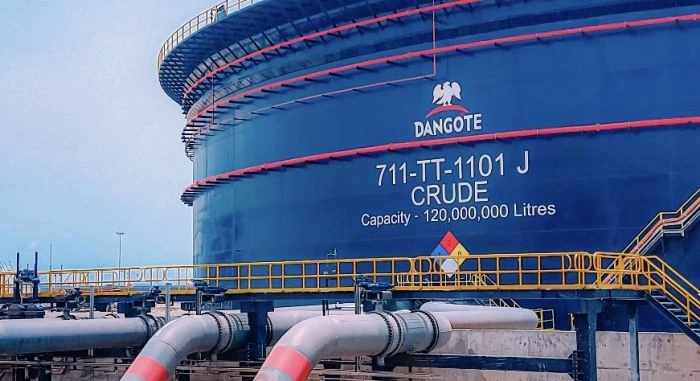
The Dangote Petroleum Refinery has defended its recent round of fuel price increases, attributing the adjustments to the cost of crude oil purchased earlier and the lengthy process involved in sourcing, shipping and delivering crude to the refinery.
The clarification comes as the price of Premium Motor Spirit continues to climb nationwide, with the product now retailing between N1,310 and N1,400 per litre depending on location. Petrol currently sells for about N1,310 per litre in Lagos and Ogun states, while prices have risen to N1,350 or higher in northern states and other markets farther from the refinery.
The latest increase followed Dangote’s decision to raise its PMS gantry price by N65 per litre from N1,200 to N1,265 — effective August 29, marking the third upward adjustment announced by the refinery within eight days. Notably, the hikes have come even as global crude prices trend downward, despite ongoing US-Iran tensions.
However, a senior Dangote refinery executive, speaking to The PUNCH on condition of anonymity as he was not authorised to discuss the matter publicly, said prevailing international crude prices cannot solely determine the cost of petrol produced from crude the refinery had already purchased.
He explained that a substantial time lag exists between when crude is purchased and when it eventually reaches the refinery for processing.
Posing a series of questions, he said: “If you want to buy crude at today’s price, when do you think you will complete the actual transaction to purchase the crude? When will you get a laycan? When can you get a ship chartered and a charter party agreement signed? When will the ship go to load the crude and secure the laycan for discharge? When is the sailing time before the crude eventually gets into your tank?”
He also questioned how the refinery should account for the large volumes of crude it purchased earlier at higher prices. “And what will happen to the huge quantities of expensive crude that you bought long ago and stored in the tanks? These are the factors determining the change in prices, not an immediate crude price change,” he said.
This explanation forms the core of Dangote’s defence against criticism that its repeated petrol price hikes have persisted despite falling international crude benchmarks.
Timeline of Price Increases
The refinery first raised its gantry price from N1,165 to N1,185 per litre on August 21. Five days later, it added another N15, bringing the price to N1,200 on August 26. Then, on Saturday, August 29, it announced a further N65 increase, pushing the price to N1,265 per litre.
Altogether, the three adjustments raised Dangote’s gantry price by N100 per litre about 8.6 per cent within eight days. The latest increase also moved the refinery’s coastal PMS price from N1,582,380 to N1,669,545 per metric tonne.
In its price communication, the refinery directed customers to return their existing Authorisations to Collect for repricing, noting that new volume contracts would be issued to allow loading to resume immediately.
Retail Impact
The effects of the latest adjustment are already visible at the pumps, with petrol selling at about N1,310 per litre in Lagos and Ogun, and N1,350 or more in parts of the North and other distant markets. In some locations, prices are reportedly approaching N1,400 per litre.
The variation in pump prices across regions is partly linked to the cost of transporting petrol from the coastal refinery and depots to distant markets, with logistics and distribution expenses adding to the final price. This is part of the reason Dangote plans to expand its free distribution scheme nationwide.
Crude Price vs. Pump Price: A Widening Gap in Question
The latest increase has renewed scrutiny of the relationship between international crude prices, refined product costs and the pricing decisions of domestic refiners.
According to the Major Energies Marketers Association of Nigeria’s Energy Bulletin for August 27, Dangote’s PMS gantry price stood at N1,200 per litre that day, while the estimated spot import-parity price of petrol into tanks was N1,222.32 per litre, and the NPSC-NOJ spot estimate stood at N1,221.32 per litre. This meant Dangote’s gantry price was N22.32 below the spot import-parity estimate as of August 27.
Two days later, however, the refinery raised its gantry price to N1,265 per litre placing it N42.68 above the August 27 import-parity estimate. It remains unclear whether the import parity figure has since changed.
The crude market has remained volatile amid geopolitical tensions between Iran and the United States, alongside uncertainty over crude flows through the Strait of Hormuz. According to Oilprice.com, Brent crude closed at $88 per barrel and WTI at $83 on Friday, reflecting a 5 per cent drop. The Dangote executive maintains, however, that such daily price movements do not necessarily reflect the cost of crude the refinery has already acquired.
He noted that crude procurement involves several stages negotiating and completing the purchase, securing a loading window, chartering a vessel, loading the cargo, sailing to Nigeria and securing a berth before the crude can even be discharged into the refinery’s storage tanks. As a result, crude being processed at any given time may have been purchased when international prices were markedly different from current benchmarks.
The executive also pointed to the refinery’s existing inventory, noting that large quantities of crude bought at higher prices remain in storage. Immediately cutting petrol prices whenever international benchmarks fall, he argued, could mean selling products made from expensive inventory at prices based on cheaper replacement crude — an imbalance the refinery is seeking to avoid.
This issue carries added weight for Dangote given that the refinery does not rely solely on Nigerian crude. Reuters reported on August 26 that between 30 and 40 per cent of the refinery’s crude feedstock is imported.
Marketers Voice Concern Over Volatility
The recent price hikes have heightened concerns among petroleum marketers, who warn that the volatility is complicating business planning.
The National Publicity Secretary of the Independent Petroleum Marketers Association of Nigeria, Chinedu Ukadike, said marketers are contending with multiple pressures that could drive up the cost of petrol.
“We are facing the challenges of the volatility in the market. There are policies of the government, policies of the international market, and exchange rates. These are inherent dispositions to the increase in pump prices. We are not refiners to be able to determine the price of petroleum products,” he said.
He acknowledged, however, that Dangote has historically reduced its petrol prices in response to shifts in the international market. “I also believe that Dangote has been consistent in terms of reducing its price in line with the international market rate. With this situation now, we cannot, at this particular point in time, structure our business. It’s going to be too difficult for us to structure our business,” he said.
Ukadike further warned that persistent Iran-US tensions could worsen price irregularities. “The more the Iran and United States crisis continues to persist, the more we’ll be having these irregularities in price,” he added.
He noted that these fluctuations are already showing up in retail prices across the country. “The price of crude oil is determined by the international market. So, for all the independent marketers, we will continue to strive. Prices have been fluctuating, and we are still loading. The price of petrol will continue to be volatile as long as the price of crude is not stable and other factors relating to the financial situation,” he said.
Ukadike added that marketers and consumers are ultimately bearing the brunt of these price swings.
The development comes at a time when the presidential candidate of the African Democratic Congress, former Vice President Atiku Abubakar, has proposed reintroducing fuel subsidies to ease hardship and reduce the cost of living.