“Enough Is Enough”: Tinubu Takes Xenophobia Fight to the African Union — Demands Action by January

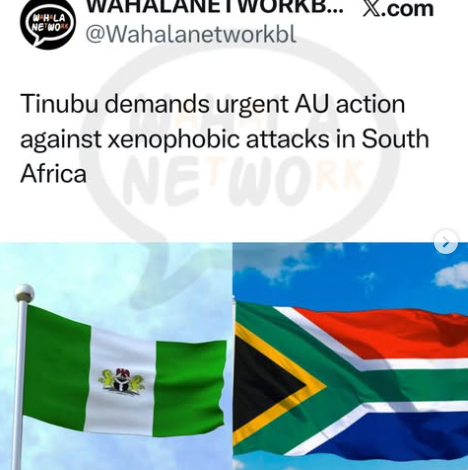
Nigeria just made its frustration with South Africa’s xenophobia crisis official and international. President Bola Tinubu has taken the matter straight to the African Union, putting the continent’s leaders on notice that this is no longer just a bilateral irritant.
What Happened
President Bola Tinubu formally reported the recurring xenophobic and Afrophobic attacks against Africans and other foreign nationals in South Africa to the African Union (AU), warning that the violence undermines continental solidarity, unity, and peaceful coexistence.
The message was delivered on Tinubu’s behalf by Vice President Kashim Shettima at the 21st Extraordinary Session of the Assembly of the African Union, held in Luanda, Angola, on Sunday. It wasn’t just a passing complaint Tinubu specifically requested that the AU place the matter on the agenda of its 40th Ordinary Session, scheduled for January 2027, for formal consideration and action.
In a statement released by Stanley Nkwocha, Senior Special Assistant to the Vice President on Media and Communications, Tinubu’s exact position was laid out clearly: “Nigeria wishes to express its concern over the recurring xenophobic and Afrophobic attacks against Africans and other nationals in South Africa.”
Careful Diplomacy, Firm Message
What’s notable about Tinubu’s approach is how deliberately balanced it was. Rather than framing this as an attack on South Africa itself, the statement explicitly acknowledged South Africa’s sovereign right to enforce its own immigration laws and recognized the country’s broader contributions to the continent. But that acknowledgment came with a clear line drawn: sovereignty over immigration policy is one thing violence and hostility toward fellow Africans is another entirely, and the two shouldn’t be conflated.
According to the statement, Nigeria stressed that “such attacks undermine African solidarity, unity and peaceful coexistence, and require urgent collective attention.”
That’s a notably different tone from purely reactive outrage Nigeria is essentially asking the AU to treat this as a structural, continent-wide governance issue rather than an isolated law-and-order matter for South Africa to handle alone.
What Nigeria Is Actually Asking For
Tinubu’s appeal wasn’t just symbolic. He specifically called on the AU to:
Reaffirm its commitment to protecting the safety, dignity, and rights of all African nationals across the continent
Intensify collective efforts to combat xenophobia and Afrophobia
Place the South Africa xenophobia issue formally on the agenda for the AU’s January 2027 Ordinary Session
The push for dialogue and preventive diplomacy featured heavily in the message, with Tinubu stressing that these tools rather than after-the-fact crisis response remain essential for preserving unity across the continent.
Part of a Bigger Continental Security Push
Nigeria didn’t stop at xenophobia. At the same session, the country backed the adoption of the Luanda Action Plan, a proposed roadmap for strengthening conflict prevention across Africa more broadly. Tinubu’s underlying argument: prevention is simply smarter policy than crisis management. “For Nigeria, conflict prevention remains more cost-effective and sustainable than conflict management,” he said.
He also raised a pointed warning about a separate but related concern the growing involvement of foreign military forces, mercenaries, and private defence contractors in African conflicts, cautioning that this trend risks undermining the AU’s own capacity to lead its continent’s peace and security initiatives. Fragmented peace efforts paired with rising external interference, in Tinubu’s framing, represent a genuine threat to African-led solutions.
Why This Matters
Xenophobic violence in South Africa often targeting Nigerian nationals and other African migrants has been a recurring diplomatic flashpoint between Abuja and Pretoria for years, periodically flaring into deadly riots, looting, and attacks on foreign-owned businesses. What makes this latest move different is the venue: rather than another bilateral protest note or strongly worded press statement aimed directly at Pretoria, Tinubu chose to formally escalate the issue to the entire African Union assembly turning it into a continental accountability question rather than a Nigeria-versus-South-Africa dispute.
By requesting a spot on the AU’s January 2027 agenda, Nigeria is also setting a concrete timeline for the continent’s leadership to actually respond, rather than letting the complaint fade into the usual cycle of statements without follow-through.
What Happens Next
For now, the ball is in the African Union’s court. Whether the issue makes it onto and survives the agenda for the 40th Ordinary Session in January 2027 will be the real test of whether this latest push produces anything more concrete than the diplomatic language exchanged at past AU gatherings.
For the Nigerians and other African nationals living in South Africa who continue to face these recurring attacks, that January deadline is now something worth watching closely.