Digital Trail Doesn’t Lie: Omaha Man Gets 10 Years After Using ChatGPT to Plan a Bank Robbery

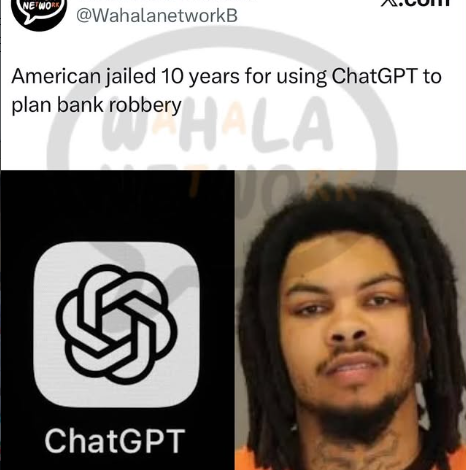
Technology leaves receipts, and this case proves it in the most literal way possible. A 23-year-old Nebraska man who used ChatGPT while planning an armed bank robbery has been sentenced to 121 months just over 10 years in federal prison.
What Actually Happened
The case stemmed from a robbery at i3Bank on Spaulding Street in Omaha on February 10, 2026. Court documents said Deron Lewis-Payne entered the bank carrying a black semi-automatic Llama Mini-Max .45 handgun and demanded money from two employees. He was seen clearly on surveillance video and was later spotted driving a truck with distinctive features. After the robbery, he went on a shopping spree at Westroads Mall for clothes. When officers later located him near one of his residences, he fled on foot, dropping banded cash as he ran. Searches of his residences turned up a currency band, the vehicle used in the robbery, and most of the clothing worn during the incident including a distinctive pair of red slides. Of the approximately $9,175 stolen, investigators recovered $2,397. The handgun used in the robbery was never recovered.
How ChatGPT Entered the Case
Lewis-Payne admitted to driving the vehicle but initially denied involvement in the robbery itself. He consented to a search of his phone, and when officers examined its contents, they discovered he had used ChatGPT to help plan the crime. According to the Department of Justice, his interactions with the AI chatbot included seeking information about law enforcement response times, how to strip and repair the handgun, and how to obtain ammunition despite being a convicted felon. Investigators also found that his Google Maps search history showed he had recently searched for directions to i3Bank.
The case has drawn attention as one of the more documented examples of AI tools being used in the planning of a violent crime, even as investigators noted that Lewis-Payne left behind a significant trail of digital and physical evidence despite his preparations.
The Sentence
Lewis-Payne was sentenced on August 13, 2026, after pleading guilty to bank robbery and brandishing a firearm during a crime of violence. US District Court Judge Robert F. Rossiter Jr. handed down 37 months for the bank robbery charge and an additional 84 months for brandishing the firearm, with the two sentences to run consecutively. He will also serve five years of supervised release after completing his prison term, and as with all federal sentences there is no parole available. US Attorney Lesley A. Woods announced the sentencing, with the case investigated by the Federal Bureau of Investigation.
Why This Case Is Getting Global Attention
Beyond the robbery itself, this case has become a talking point precisely because of what it reveals about how AI chat histories are increasingly becoming evidence in criminal investigations. Despite planning meticulously enough to research police response times and how to obtain ammunition as a convicted felon, Lewis-Payne still left behind an unmistakable digital footprint chat logs, map searches, and surveillance footage that made the case against him overwhelming. It’s a stark reminder that AI tools don’t offer anonymity or protection from investigators; if anything, they can create an entirely new category of evidence.
Wahala Network Take
Using AI to plan a crime doesn’t erase the trail if anything, it adds a whole new layer of it. Ten years and a month in federal prison, no parole, and a digital record that told investigators exactly what he’d been asking and searching for. A cautionary tale for anyone who thinks a chatbot conversation stays private.